The brief
A surf club and coastal leisure venue on the Australian coast was refitting the beach-facing side of its building — a new entrance canopy over the main doors, fresh render, and a reworked first-floor balcony rail. The club wanted its presence to match the position: a building that sits almost on the sand, read by people walking the promenade, by swimmers coming up from the water, and by traffic on the road behind the dunes. Before the refit the frontage went dark the moment the afternoon light dropped, and the entrance disappeared into the row of neighbouring buildings.
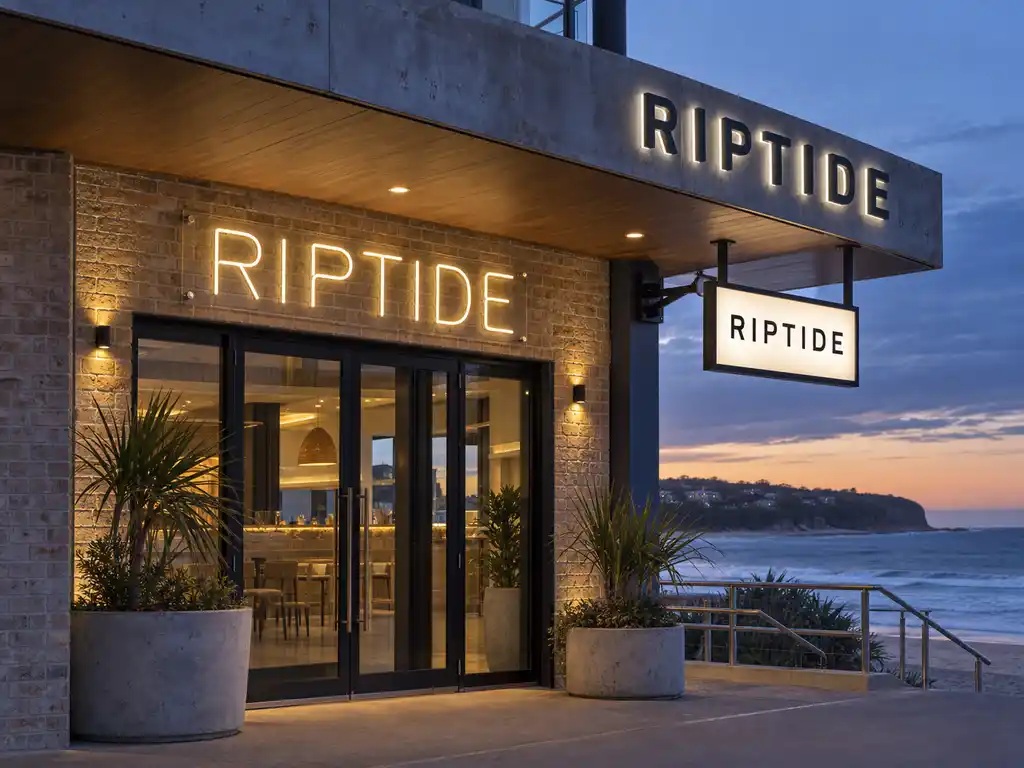
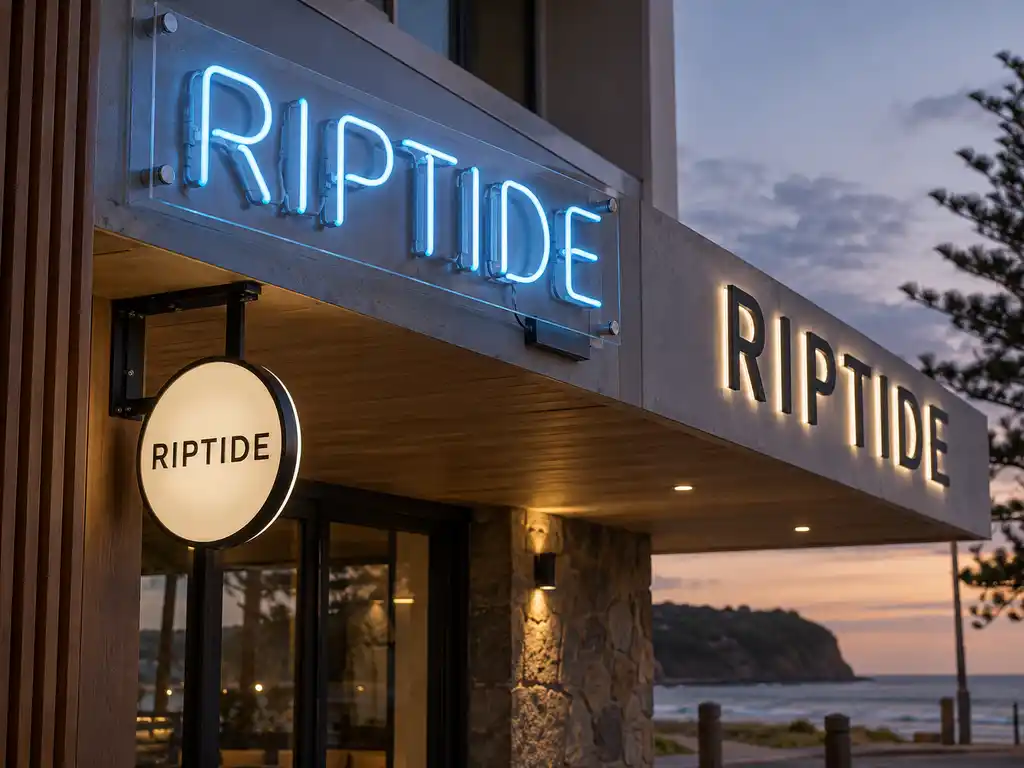
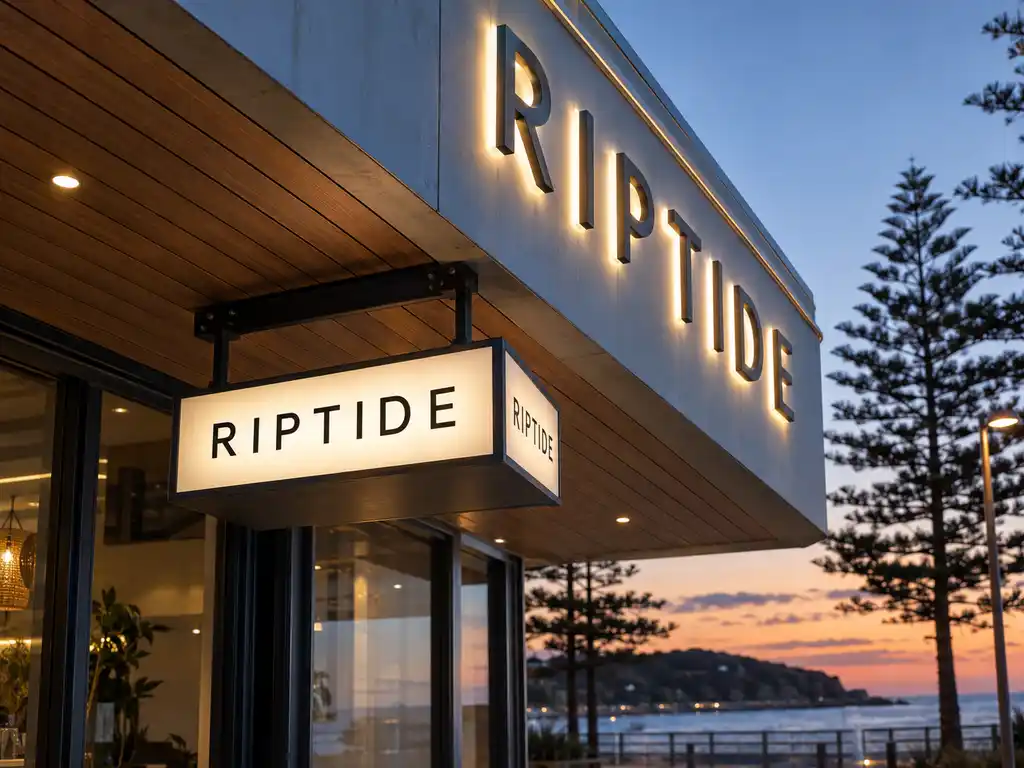
Two pieces were asked for. First, a neon statement piece for the wall above the entrance — soft, hand-drawn lettering that reads as a surf club rather than a nightclub, and that photographs well for the venue’s own social posts. Second, a projecting blade sign under the new canopy, double-sided so it can be read from either direction along the beachfront path, projecting out far enough to be seen before the building itself comes into view.
The site is the constraint. The building sits a few metres from salt water with a constant onshore breeze, salt spray carried up the frontage, strong UV and fast-moving weather. Everything mounted outside has to survive a marine atmosphere, and anything hanging under the canopy sits in the one part of the building that stays damp and shaded. That made corrosion protection, sealed electricals and a finish that will not dull after one summer more important than raw brightness.
What we built
A matched set of three illuminated pieces, produced from one artwork pack so the club’s typography and light temperature stay consistent across the neon, the blade sign and the fascia.
- Interior/exterior neon wall piece: custom-shaped LED neon flex traced from the club’s own hand-lettered wordmark, mounted on a clear acrylic backing
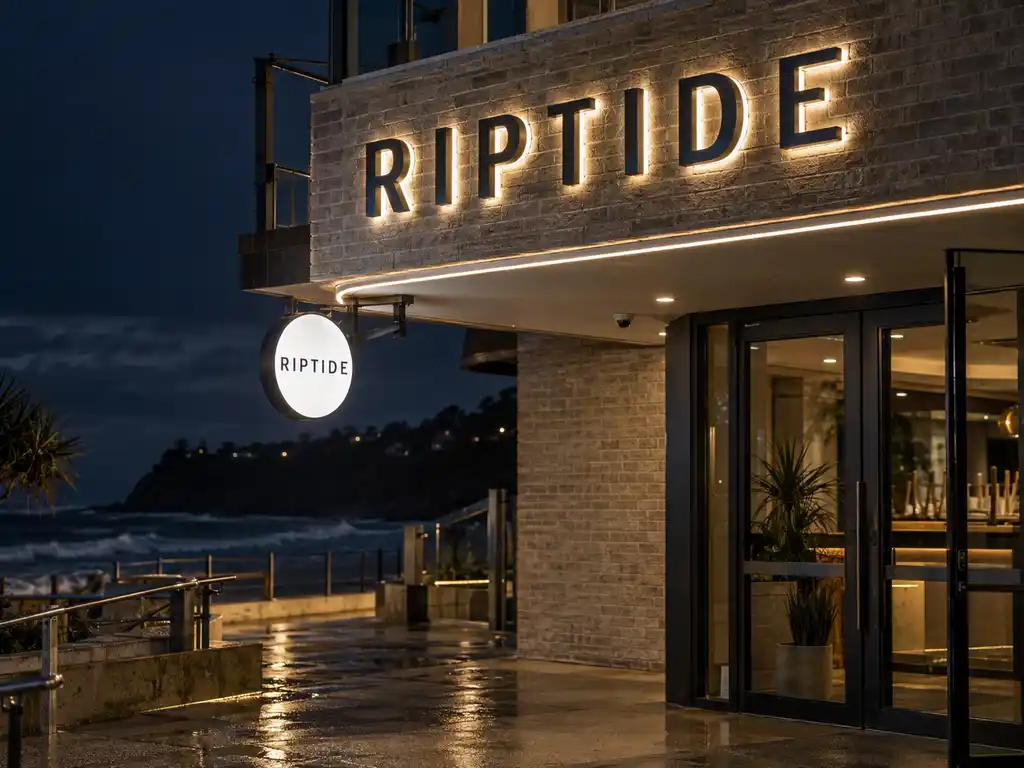
- Projecting blade sign: a double-sided hanging light box in a powder-coated aluminium frame with translucent polycarbonate faces over an internal LED array, suspended from the new canopy frame
- Fascia letters: stainless steel back-lit letters with an electroplated finish for the exposed section of wall where the canopy does not reach
- Materials: LED neon flex on acrylic backing for the soft neon piece; powder-coated aluminium, translucent polycarbonate faces and an internal LED array for the double-sided blade sign; stainless steel with an electroplated finish and LED backlighting for the weather-exposed fascia letters
- Electrical: 12V LED neon flex on a remote driver inside the shopfront joinery, with the driver for the blade sign located inside the canopy rather than in the sign itself, keeping low-voltage connections out of the salt-air run
- Coastal protection: electroplated stainless steel specified for the fully exposed letters because the finish is corrosion and weather resistant, plus powder-coated aluminium construction for the blade sign housing, sealed cable entry and UV-resistant faces across the set
- Lighting character: warm white throughout, set to read clearly along the promenade after dark without spilling light into the balcony and windows above
- Mounting and services: pre-drilled backings on stud fixings, a cable suspension system for the hanging blade sign, and a 1:1 layout template, wiring diagram and installation notes supplied for the builder
How the project ran
The canopy and render were still going up when we came on board, so the first job was setting out against a facade that kept moving. The canopy frame went in ahead of the finished render, and the paving at the entrance was re-laid late in the programme, shifting the ground line by a few centimetres. We worked from site photographs, the canopy’s own fabrication drawings and a set of dimensions confirmed at the frame, then issued a scaled layout showing each piece in position and how the blade sign would read from both ends of the beachfront path.
The blade sign carried the most design risk. A projecting sign is only ever seen at an angle, and the reading distance is fixed by the canopy height, so letter size, sign depth and light output had to be resolved against that geometry instead of a showroom sample. Sizing the internal LED array for even, shadow-free illumination on both faces is what keeps the two sides reading the same from across the road as they do under the sign.
The material call was made early and deliberately. For the letters exposed to direct weather we specified electroplated stainless steel rather than a painted finish, because salt air and UV dull an unprotected surface long before the LEDs reach the end of their working life. For the blade sign we kept a powder-coated aluminium frame rather than an untreated housing for the same reason. The neon piece is the one soft element in the set and stays in the sheltered zone above the entrance, so it keeps its flexible construction and warm glow without exposing the driver to the weather.
Because the club stayed open through the fit-out, we produced a full-size prototype character for the fascia set and signed off stroke weight, colour temperature and finish against the painted render before the rest of the set went into production.
Delivery and installation
The finished pieces shipped by air freight in individual crates with mounting hardware, the remote drivers, the cable suspension kit for the blade sign, a wiring diagram and installation notes packed alongside them. The club’s own contractor installed everything, which let the trades work to their own programme instead of closing the venue for a separate fit-out window.
Every piece was supplied with a 1:1 template so the fixings could be marked out and drilled once, and the blade sign was set out so its suspension points landed on the canopy’s structural frame rather than the sheeting. The blade sign driver sits inside the canopy with a short, sealed cable run into the sign, so the low-voltage connections stay away from the damp underside and any future change to the neon wall is a sign-off rather than an electrical job. Stud bolts, washers and nuts were supplied for each mounting point.
Outcome
The club now reads from both directions along the beachfront. The projecting blade sign catches the eye before the building itself is in view, the neon gives the entrance a warm, photographable focal point that suits a surf club rather than a bar, and the fascia letters pick up the exposed wall section so the frontage stays legible at a glance after dark.
Choosing electroplated stainless steel for the exposed letters and a powder-coated aluminium frame for the blade sign means the set should hold its finish through coastal summers rather than pitting and fading after the first season. The operator holds the approved production files for every piece, so a damaged character, a replacement face panel or a future second site can be ordered against the original artwork and match the existing signage exactly.
The pieces used on this project are the custom shaped neon lights, the double-sided hanging light box and the stainless steel back-lit letter signs.