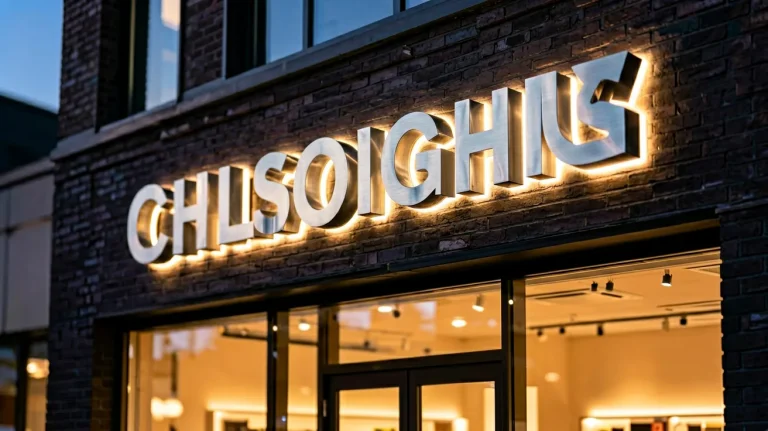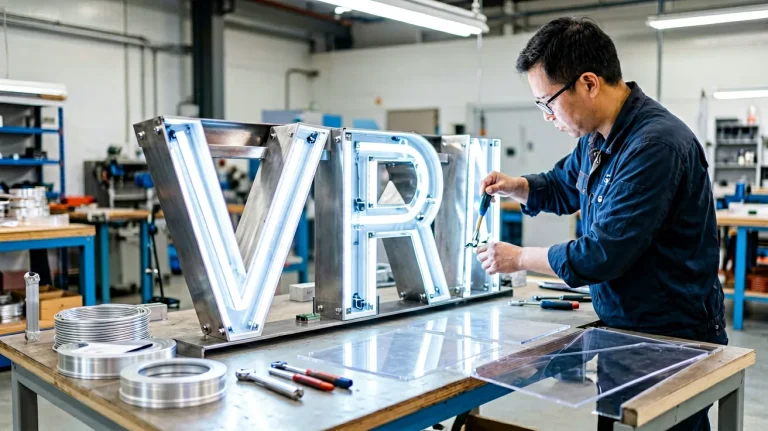
When a business commissioning illuminated signage looks beyond the storefront, outdoor channel letters face a far harsher environment than any interior sign ever will. Wind gusts, driving rain, extreme temperature swings, and relentless UV exposure demand more than a pretty acrylic face — they require a construction system engineered from the ground up for exterior durability. That is exactly why we specify marine-grade aluminum return frames, 304 stainless-steel facades, and IP65-rated LED assemblies across our outdoor channel letter product line.
Why Stainless Steel and Aluminum Dominate Outdoor Applications
Acrylic faces alone cannot survive the outdoor environment. Without a rigid, corrosion-resistant housing, the letter structure flexes, warps, and eventually fails at the seams where water infiltrates. Our factory has spent over ten years refining material selections for exterior signage, and the consensus is clear: aluminum returns with powder-coat finishes or 304 stainless-steel facades deliver the longest operational life with the lowest maintenance burden.
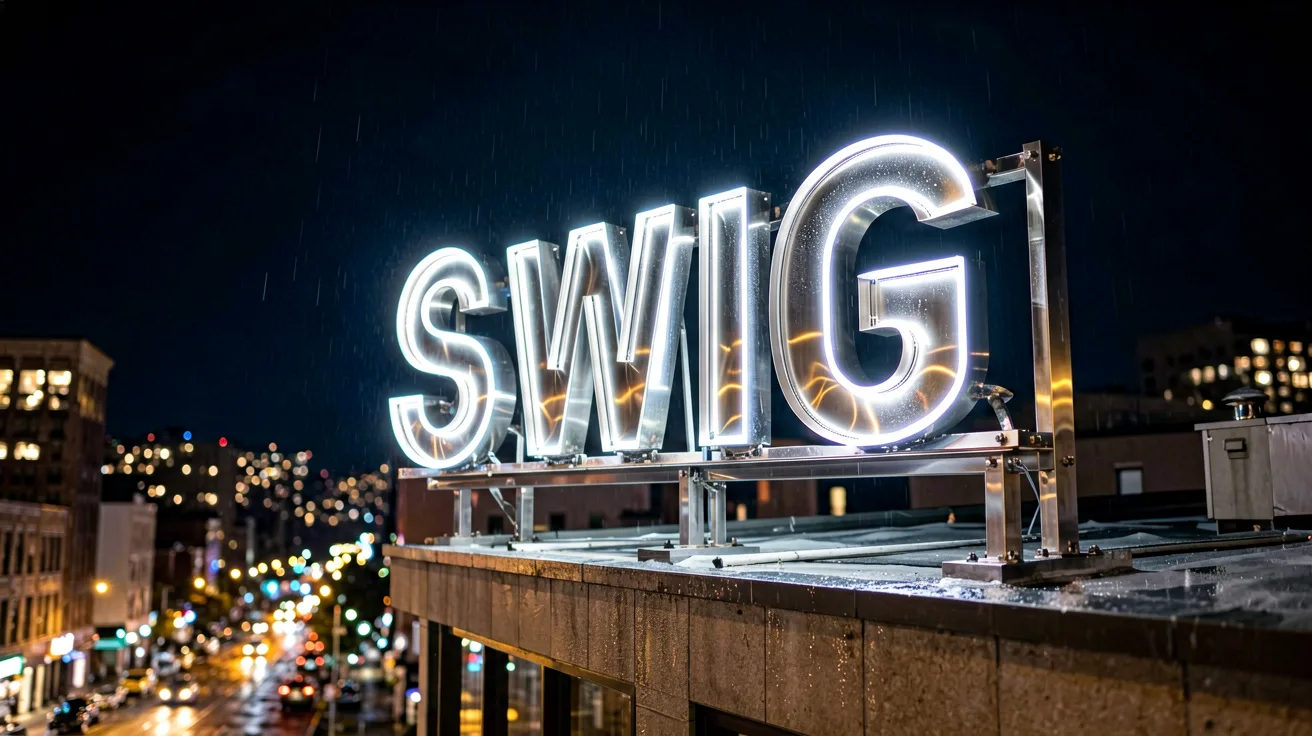
Aluminum channels are lightweight, which matters enormously when letters are mounted high on a building facade or cantilevered from a rooftop parapet. The material resists oxidation naturally, and a quality powder-coat finish — typically a polyester or fluorocarbon system rated for 2,000-plus hours of QUV accelerated weathering — adds an extra barrier against salt spray and industrial atmospheric corrosion. For coastal installations or regions with heavy road-deicing salts, we recommend 304 stainless-steel faces paired with aluminum returns, a combination that handles salt-laden air without staining or pitting over decades of exposure.
For projects where a specific metallic aesthetic is required — brushed silver, mirror chrome, or a custom RAL color — large 3D outdoor site letters in stainless steel offer the structural integrity and visual impact that commercial clients expect for landmark and monument signage.
IP65 Waterproofing and LED Driver Protection
IP65 is the baseline waterproof rating we enforce for all outdoor channel letter assemblies. The “6” denotes complete dust ingress protection — no particulate can enter the letter housing and compromise the LED modules or their interconnections. The “5” indicates protection against water jets from any direction, meaning driving rain, pressure-washing during facade maintenance, and seasonal snow melt all fail to breach the enclosure. This rating applies not only to the acrylic or polycarbonate face but to every seam, every splice in the LED tape, and every connector along the power distribution network.
The LED driver is the most vulnerable component in any illuminated sign, and outdoor installations demand special attention. We use sealed, potting-compound-filled drivers rated IP67 or higher, mounted in ventilated but weather-shielded compartments within the letter return frame. The driver housing includes gasketed conduit entries and heat-sink pathways that dissipate thermal load without allowing moisture ingress. Our quality-inspection protocol includes a one-hour continuous damp-heat test at 85 °C and 85% relative humidity before any outdoor-rated assembly leaves the factory.
Understanding the full wiring architecture behind reliable outdoor signage — including junction-box placement, conductor sizing, and overload protection — is essential for any buyer planning a multi-letter installation. Our comprehensive outdoor LED signage buyer guide covers every electrical and mechanical detail that distinguishes a sign lasting a decade from one requiring premature replacement.
UV Resistance, Corrosion Control, and Thermal Cycling
UV radiation is the silent killer of outdoor signage. Without proper stabilization, acrylic faces yellow and lose透光率 within two to three years of direct sunlight exposure, and polycarbonate faces develop micro-cracking at stress points. Our outdoor-rated acrylic incorporates UV-absorbing copolymers tested to retain over 92% of its original light transmission after 5,000 hours of xenon-arc exposure, roughly equivalent to eight to ten years of Florida or Arizona sun.
Thermal cycling between daytime highs and nighttime lows imposes repeated expansion and contraction on every joint and fastener in the letter assembly. Aluminum and stainless steel have closely matched coefficients of thermal expansion, which minimizes differential movement at the face-to-return interface. We design our channel letter returns with slip-fit allowances at expansion joints, preventing the buildup of stress that would otherwise crack the face panel or fatigue the silicone sealants over time.
For a detailed comparison of illumination strategies and their respective outdoor performance profiles, review our backlit versus front-lit LED channel letters article, which breaks down the trade-offs in luminance, weather resilience, and energy consumption for each approach.
Wind, Rain, and Structural Loads on Building Facades
Outdoor channel letters are subjected to wind pressures that increase dramatically with mounting height. A 1.2-meter-tall letter assembly on a second-story facade can experience wind loads exceeding 150 kg per square meter during a severe storm, and the moment arm created by cantilevered mounting multiplies the stress on every anchor point. Our engineering team provides free structural calculation drawings for every outdoor project, verifying that the proposed mounting hardware — whether standoffs, raceway brackets, or direct-to-concrete anchors — meets or exceeds the ASCE 7 wind-load requirements for the installation region.
Rainwater management is equally critical. Channel letter returns are designed with integrated weep holes and drainage channels that prevent water from pooling inside the housing. Standoff-mounted letters maintain a minimum 50 mm air gap between the letter back and the wall surface, allowing rain to shed freely and promoting natural convection cooling that extends LED lifespan. For rooftop installations above parapet walls, we specify sealed base plates with raised mounting flanges that direct runoff away from the building envelope and prevent capillary wicking into the facade substrate.
Tenant Coordination and Signage Approval Considerations
Commercial landlords and property managers increasingly enforce signage guidelines that govern the appearance, illumination intensity, and mounting method of exterior tenant signs. Before committing to a channel letter design, buyers should confirm the following with the leasing office or HOA: maximum allowed font height and projection depth, permitted color temperatures (typically 3,000 K to 5,000 K for commercial districts), curfew or dimming requirements, and whether the building facade material — especially historic masonry or glass curtain walls — imposes additional constraints on drilling and anchoring.
In many jurisdictions, a sign permit is required before any outdoor illuminated letter assembly is installed. Our team prepares the structural drawings, material specifications, and photometric layouts needed for municipal review, and we can coordinate directly with the local building department to accelerate approval timelines. For landlords evaluating multiple tenant signs across a portfolio, standardizing on IP65-rated aluminum-and-stainless construction with uniform color temperatures simplifies both the approval process and long-term maintenance scheduling.
Every outdoor channel letter we produce carries CE and ROHS certification, and each unit undergoes a factory quality inspection covering LED chromaticity consistency, seal integrity, electrical safety, and structural load testing. If you are planning a facade, rooftop, or freestanding outdoor sign, request a free structural drawing from our engineering team — we will calculate wind loads, recommend mounting hardware, and confirm compliance with your local signage ordinance before production begins.
Related Products & Guides
- Outdoor Directional Block Signpost — weatherproof wayfinding signage for campus and retail environments.
- Outdoor Lighted Channel Letters: Weatherproofing & Maintenance Guide — long-term care practices for exterior channel letter installations.