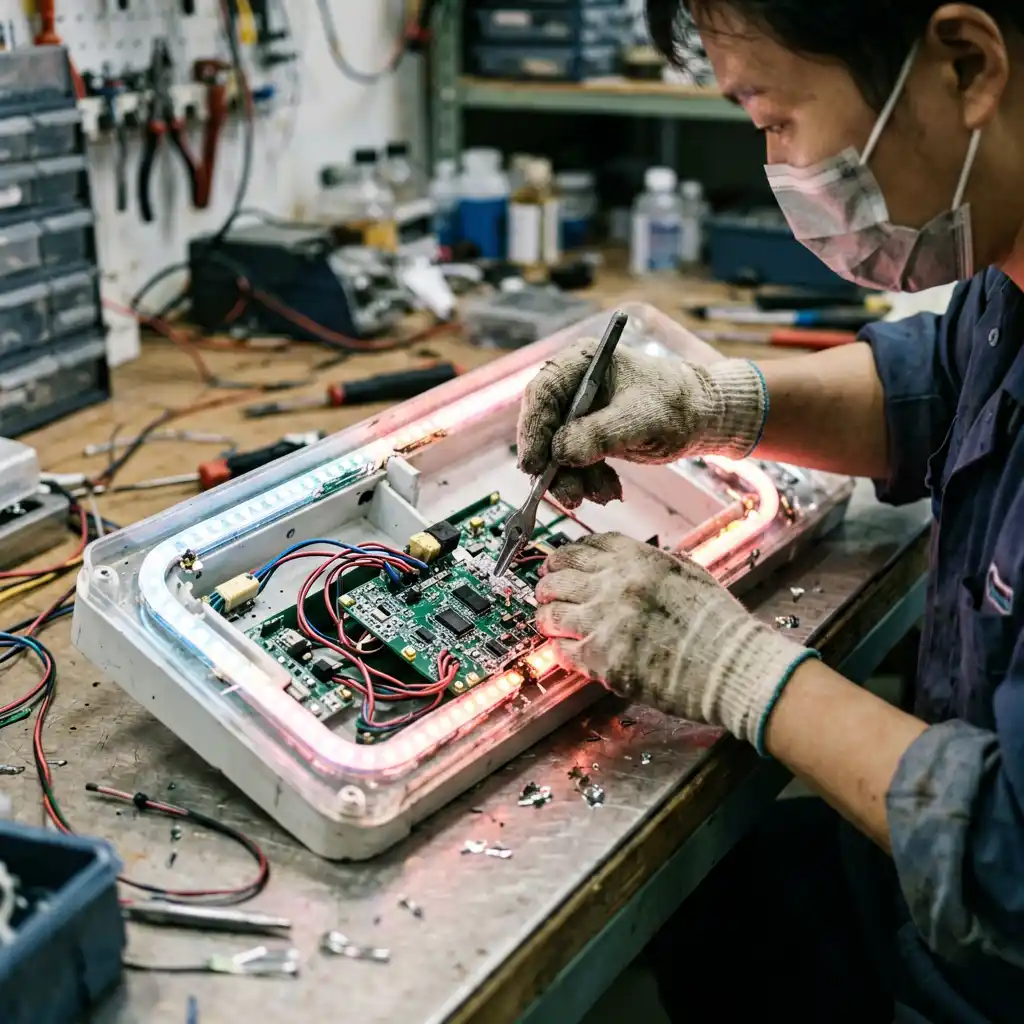


If your neon sign just went dark, you have seconds to panic and then one question: repair it or replace it? It’s the single most common question in r/neonsigns, and for good reason — a broken sign means lost curb appeal, and nobody wants to overpay for a fix that won’t last.
This guide walks through the real repair-vs-replace decision with the cost numbers owners actually report, what fails most often, and a simple checklist so you make the call in minutes, not weeks.
u/SurfShopOwner asks in r/neonsigns
Our surf shop neon sign — the big glass wave — died halfway through summer. Local guy says it needs new tubing and a transformer, quoted around $700. The sign is 12 years old. Do I pay to fix it or just buy a new LED sign? How much would it cost to fix our neon sign?
It’s a fair question, and the replies split almost exactly down the middle. Here’s what the community actually told them.
Top Comments
A neon restorer
“Glass neon is repairable, but only if the tubes are intact or the shop has the equipment to bend new ones. If the glass is fine and it’s just the transformer, that’s a cheap fix. If the tubing is cracked, you’re paying for skilled labor — that’s the expensive part.”
An LED sign company
“Honestly, for a 12-year-old sign, replace it. LED neon costs a fraction of what glass repair runs, lasts 10+ years, and you’ll never have a gas leak or electrode failure. Modern LED flex is the sensible upgrade.”
A shop owner who replaced
“I repaired my glass sign twice in four years, then replaced with LED. Should have done it the first time. The repair each time was cheaper, sure, but two repairs added up to more than the new sign — and I lost business while it was down each time.”
A sign technician
“Rule of thumb: if the glass is broken, ask the shop for a tube-bending quote before assuming it’s toast. But check the transformer age too. Two or more failures in three years and you’re throwing money at an old system.”
A cost-conscious owner
“Get at least two quotes. Sign shops vary wildly on labor. One quoted me $650, another $380 for the same transformer job. And ask whether they’ll warranty the repair — that tells you how confident they are.”
Repair vs Replace Cost Reality
Here’s the honest money picture for a typical single-face sign. Repair costs are labor-heavy because glass neon needs a skilled tube-bender; LED is mostly plug-and-play components.
| Option | Typical Cost Range | Lifespan | When It Wins |
|---|---|---|---|
| Glass neon repair — transformer swap | $150–$400 | 3–6 yrs | Glass intact, sign under ~8 yrs old |
| Glass neon repair — re-tube / bend new glass | $500–$1,200 | 8–12 yrs | Iconic original glass you want to keep |
| New LED neon sign | $300–$1,500 | 10–15 yrs | Sign is old, already failed twice, or glass is shattered |
| New LED channel letter / light box | $500–$2,500 | 10–15 yrs | Full brand refresh or relocation |
The math flips when you’ve repaired the same sign before. One $400 fix is cheaper than a replacement — but the third repair in five years is almost always worse than one new LED install.
What Actually Breaks
Sign failure is rarely mysterious. Here’s what dies on both glass and LED systems, in rough order of frequency.
| Component | Common Failure | Typical Fix | Avg Fix Cost |
|---|---|---|---|
| Transformer / power supply | Burns out over time, power surges | Swap unit | $150–$400 |
| Tubing / glass breakage | Impact, thermal stress, vandalism | Re-bend tube (skilled labor) | $300–$800 |
| Electrodes & caps | Corrosion, loose connections | Replace electrodes | $80–$250 |
| LED modules / flex strips | Dead segment, driver failure | Replace strip section | $50–$300 |
Notice the pattern: the expensive failures on glass neon are the ones that need a human with a torch. LED failures are component swaps anyone can do with a screwdriver.
LED Neon: The Zero-Maintenance Alternative
This is why so many owners migrate. LED flex neon has no gas, no glass, and no electrodes to corrode. The failure mode that kills glass signs — tube breakage — is nearly eliminated, and transit damage is under 1% because the strips flex instead of shattering.
A well-built LED sign runs 10–15 years with essentially no maintenance beyond a wipe-down and a loose-connection check. No re-gassing, no tube-bending, no electrode replacement. For a storefront that can’t afford downtime, that reliability is the real value — see the full breakdown in LED neon vs glass neon.
How to Decide
Run through this checklist before you call anyone:
- How old is the sign? Under 8 years and glass intact → repair usually wins. Over 12 years → lean replace.
- Is this the 2nd+ failure? More than two repairs in three years → replace. You’re subsidizing a dying system.
- Is the glass broken? Intact glass = cheap transformer fix. Shattered tubes = expensive re-bend, and replacement starts to look better.
- Get 2 quotes. Pricing varies wildly. A warranty on the repair is a good sign of confidence.
- Is the sign on your critical path? If downtime costs you customers, the reliability of LED outweighs a cheaper repair.
- Still love the glass look? Genuine glass neon can be worth preserving for its glow and nostalgia — budget for it deliberately.
Bottom Line
Repair the glass if it’s young, intact, and this is the first failure. Replace with LED if it’s old, repeatedly failing, or the glass is shattered. When in doubt, price a new LED sign against the lifetime of repairs, not just today’s quote — the replacement almost always wins over a five-year view.
Want a straight answer for your specific sign? Send us a photo and we’ll tell you whether repair or replacement makes sense — contact our team for a no-pressure assessment. And if you’re shopping, compare vintage neon letter signs and custom-shaped neon lights, or start with our channel letter cost guide and channel letters guide.